




The University of Colorado is changing the pay schedule for nonexempt employees to align with standard payroll practices, as part of the Time & Labor project.
Beginning Sept. 27, 2026, nonexemptNonexemptOvertime-eligible employees will transition from being paid monthly as earnings occur to being paid biweekly in arrearsArrearsThe practice of paying employees for work completed during a previous pay period rather than the current one..
We understand that changes to pay timing can feel stressful. CU is committed to transparency, support, and ensuring that employees have the necessary information and resources throughout this transition. Supervisors and HR professionals received an initial communication about the Payday Schedule Change on Jan. 15, 2026, and nonexemptNonexemptOvertime-eligible employees will receive notifications on Jan. 22, 2026.
What is changing?
Under the new pay schedule:
- Nonexempt employees will be paid in arrearsArrearsThe practice of paying employees for work completed during a previous pay period rather than the current one., which means approximately two weeks after hours are worked.
- Total pay and pay rates are not changing.
- This is a one-time transition to a new, ongoing pay cycle.
Once the transition is complete, paychecks will continue on a consistent and predictable schedule.
Why CU is implementing this change
The university is adjusting pay and timekeeping processes to:
- Improve payroll accuracy and reduce manual corrections.
- Reduce the lag time between earning federal overtime and being paid earned federal overtime.
- Improve the timeliness of first paychecks for newly hired employees.
- Pay in arrearsArrearsThe practice of paying employees for work completed during a previous pay period rather than the current one. allows leave taken in a pay period to be fully processed before payroll runs, aligning how leave balances are reflected on paystubs.
- Standardize timekeeping practices across all CU campuses.
- Continue to align with industry standards for payroll and Fair Labor Standards Act (FLSA) compliance.
With these key objectives, the four university campuses, CU leadership and Employee Services aligned to implement this change after a thorough analysis that started in early 2024.
What this means for you
During the transition period:
- There will be a delay between when hours are worked and when they are paid.
- You will not lose any earned pay.
- If you are confirmed as a nonexemptNonexemptOvertime-eligible employee who will move from monthly to biweekly pay, you will receive a one-time transition payment to help adjust to the new schedule and to cover the time between your last monthly payday and the first biweekly payday. See the Transition Payment section below.
Key Dates & Pay Timeline
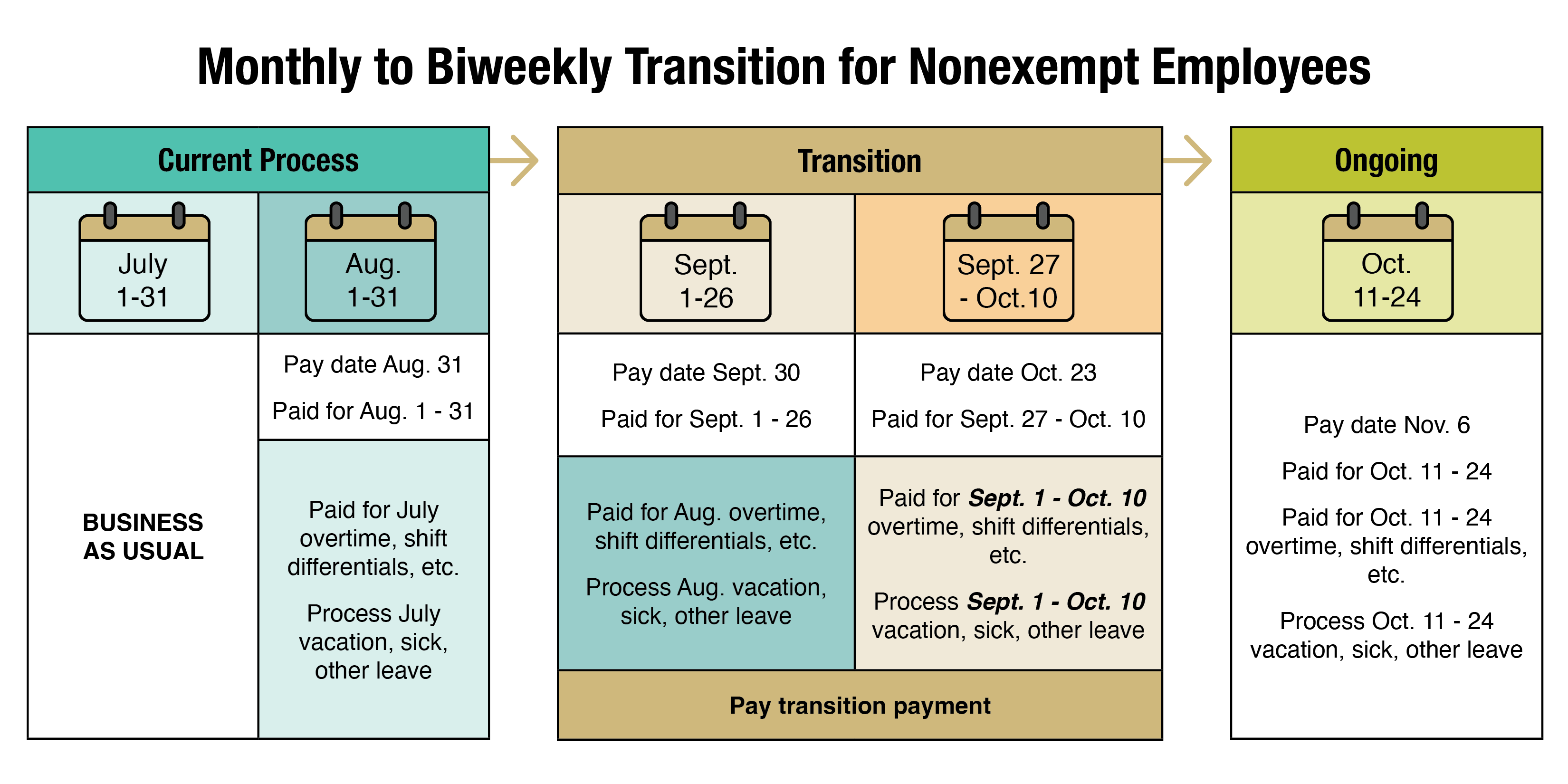
- The last monthly payday for nonexemptNonexemptOvertime-eligible employees moving to biweekly will be Sept. 30, 2026.
- The first biweekly pay period will run Sept. 27–Oct. 10, 2026.
- The first biweekly payday will be Oct. 23, 2026.
What are the differences between monthly and biweekly pay?
| Factor | Monthly (advanced/assumed hours) | Biweekly (arrears/actual hours) |
|---|---|---|
| Pay Timing | Last business day of the month, e.g. Aug. 30 for assumed August work | Every other Friday |
| Hours Covered | Entire month, assuming all hours worked, with adjustments applied the following month | Actual hours from previous two weeks paid (includes work and PTO/Leave) |
| Corrections | Actual hours from previous month leave/overtime adjusted the next month | Included in the next check automatically |
| Frequency | 12 times per year | 26 times per year |
| Employee Impact | Larger checks, less frequent | Smaller checks, more frequent |
Transition Payment
CU understands that a payday shift can feel significant for employees. Though wages remain the same, to help affected employees adjust to the timing of the transition, each campus will provide a one-time transition payment in the fall. Eligible nonexempt employees will be notified by their campus during the summer if they will receive a transition payment in the fall.
Note: The transition payment is only being offered to nonexemptNonexemptOvertime-eligible employees hired before Sept. 1, 2026, who will be transitioning from monthly to biweekly pay.
This payment is designed to provide support during the change. It is not identical to your monthly pay because:
- It is taxed differently.
- It does not include retirement contributions.
- It excludes special pay and overtime.
What amount will my transition payment be?
More information and supporting resources will be shared closer to the transition payment date to help inform expectations around the amount. Any estimates provided will be approximate and may differ from the final amount paid out.
When will I receive the transition payment?
Our goal is to provide the transitional payment in late September or early October. The Time and Labor project recently moved from the Build Phase to the Testing Phase. During testing, we hope to be able to provide a more definite date. Each campus will send communications to the affected employees once a date is selected.
Tools & Resources
To help you prepare, CU is committed to offering planning tools and support resources. More resources will be provided as we approach implementation.
Employee Toolkit
- Employee Guide and FAQ (PDF)
- Employee Payday Schedule Change Checklist (PDF)
- Support and Resources (PDF)
- Transition Timetable (Fall 2026) (PDF)
Supervisor Toolkit
- Toolkit Resources (authentication required)
Leadership Toolkit
- Toolkit Resources (authentication required)
Budgeting & Planning Support (Coming soon)
- Short-term budgeting worksheet
- Tips for managing expenses during the transition period
- Financial wellness resources
FAQs
How do I confirm whether I am a nonexempt employee?
Many CU employees are exempt from overtime pay, meaning they do not receive extra pay for working more than 40 hours a week, otherwise known as exempt employees.
Nonexempt employees are those who are eligible to earn overtime pay.
If you are eligible for overtime pay, then you are a nonexempt employee.
If you're still unsure, ask your supervisor or check your job code on your paycheck.
(click to enlarge)

If your pay group is Overtime Eligible (OT Eligible), you are a nonexempt employee and will transition to biweekly pay starting Sept. 27, 2026.
Will I miss a paycheck?
No. All hours worked will be paid. This is a timing change, not a pay reduction.
Can I opt out of this payment change?
No. This transition is required as part of the Time & Labor project.
Is my total annual pay changing?
No. Your pay rate and total compensation remain the same.
Why is CU making this change?
Paying biweekly in arrearsArrearsThe practice of paying employees for work completed during a previous pay period rather than the current one. allows for more accurate payroll processing and better aligns with standard payroll practices.
What happens if I leave CU during the transition?
You will be paid for all hours worked, including any hours earned but not yet paid.
Who can I talk to if I'm concerned about my situation?
Campus HR offices are available to provide individualized support:
- CU Anschutz: human.resources@cuanschutz.edu
- CU Boulder: PDSC@colorado.edu
- UCCS: hrhelp@uccs.edu
- CU Denver: timeandlabor@ucdenver.edu
- CU System: systemhr@cu.edu
Can other employees move to biweekly pay?
Exempt employees may have an opt-in period in 2027 to switch to biweekly pay if they choose. Each campus will determine the opt-in period.
What if I have multiple appointments?
Employees with multiple appointments have more complex job structures. We are reviewing their Fair Labor Standards Act (FLSA) status (exempt or nonexempt) to ensure pay group alignment for employees with multiple appointments is accurate before making a final determination. If you have multiple appointments, you will receive individualized updates as soon as the review is completed, before the September go-live.
How will nonexempt employees be paid under the new schedule?
Nonexempt employees will receive pay every two weeks for hours worked and approved in the new Time and Labor (T&L) system.
Note: Payroll is processed after the two-week period worked. E.g., For two weeks from Sept. 27, 2026, through Oct. 10, 2026, the payday is Oct. 23, 2026.