




The Office of Ethics, Risk and Compliance (OERC) at CU System Administration holds all hearings under the Sexual Misconduct, Intimate Partner Violence, and Stalking Policy for all CU campuses. For more detailed information on hearings at CU, review the OERC’s Hearing Manual (PDF) and the summary of what to expect before, during, and after the hearing below.
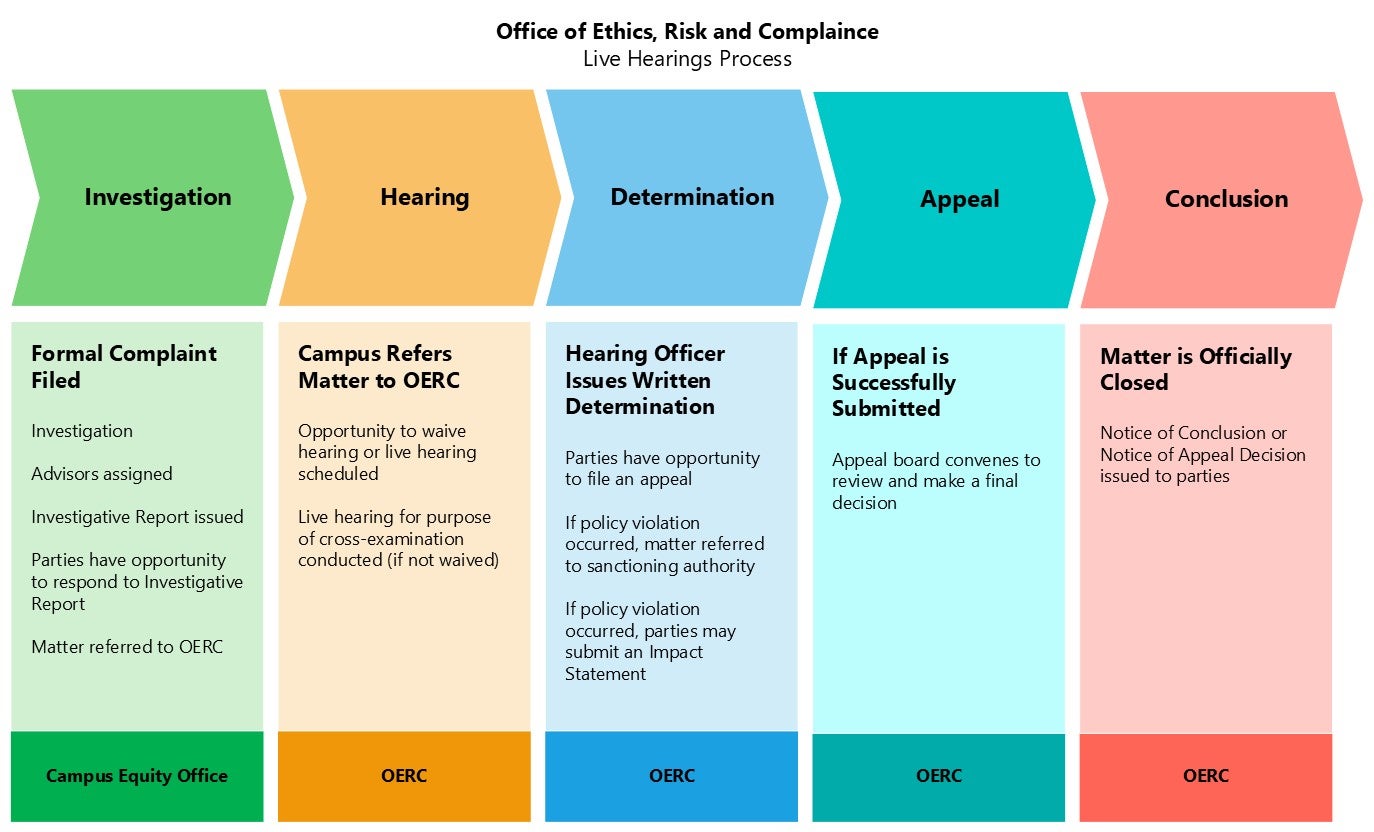
Before the Hearing
1. Assigning Advisors
Each party may have an advisor of their choice at the hearing. If you do not have an advisor, the OERC will provide you with an advisor free of charge. The role of the advisor is to ask questions of the other party and witnesses at the live hearing. The parties may not ask each other questions directly at the hearing, therefore both parties must have an advisor present. If the OERC is providing you with an advisor, you will receive an email introduction to your advisor before the Final Investigative Report is issued.
2. Scheduling the Hearing
A few days after the deadline for submitting the response to the Final Investigative Report, the OERC will contact you by email with information about the hearing. That email will cover:
The Opportunity to Waive the Hearing
We will ask all parties how they plan on participating in the hearing process. If all parties indicate that they do not wish to participate and would prefer to waive the hearing, the entire case file will be sent directly to a hearing officer to make a decision.
The Request for Scheduling
The OERC has designated Wednesdays and Fridays as hearing days. We will provide dates, falling on Wednesdays and Fridays, within a two-week period for parties to choose from for scheduling. To help us avoid delays, we ask that you and your advisor make every effort to be available on the dates provided. With rare exception, we will limit scheduling to the dates we’ve offered. If you are unable to participate in the hearing on one of the dates due to your advisor’s availability, we can provide an alternate advisor for you.
3. Preparing for the Hearing
Once the hearing has been scheduled, the OERC will request some important information from you in preparation for the live hearing. An email will be sent with deadlines for submitting the following information:
Selecting Witnesses and Evidence
We ask you to provide the names of witnesses you would like to have answer questions at the hearing. The OERC will reach out to the witnesses you identified with a request to appear but cannot require them to do so.
- New witnesses who were not part of the investigative report cannot be requested to take part in the hearing.
- If you plan to request that the investigator for this matter appear to be questioned, you must show good cause for doing so.
- Good cause includes: (1) procedural irregularities related to the investigation; or (2) bias or conflict of interest for or against a party or for or against complainants or respondents in general.
- We also ask that you identify the evidence you plan to ask questions about at the hearing so that we can have them ready and available for sharing.
- New documents that were not shared with investigators cannot be included in the hearing.
Confirming Party Participation
The hearing facilitator will ask that you let us know if you plan to participate in the live hearing and cross-examination process, if asked to do so.
- You may change your mind about participation at any point in the process.
- If you choose not to participate in the cross-examination or hearing process at all, the hearing officer cannot use your lack of participation to draw any conclusions.
Naming Optional Support Person
You are given the option of having a support person, in addition to your advisor, present at the live hearing. If you choose to have a support person present, we will ask you to share the name of this person. The support person is not allowed to speak on your behalf.
During the Hearing
Attending the Pre-Hearing Conference and Hearing
Both the pre-hearing conference and the live hearing will be held as a Zoom videoconference and will be recorded. Details for joining the hearing will be emailed to you several times in the weeks leading up to the hearing. In most cases, the pre-hearing conference will happen immediately before the live hearing begins, using the same Zoom link.
During the Pre-Hearing Conference
The pre-hearing conference is an opportunity for the hearing officer, hearing facilitator, parties, and their advisors to confirm or clarify details for the flow of the hearing. These details include:
- The order of witnesses
- The plan and procedures for the hearing
- Specifics about the evidentiary rules and rules of decorum
During the Hearing
The purpose of the hearing is to provide an opportunity for cross-examination of parties and witnesses, and to raise questions about evidence that was part of the investigation. At the hearing:
- The hearing facilitator will control who enters and stays in the Zoom room for cross-examination.
- Your advisor can ask each party and any witnesses questions (and follow-up questions, if they have any) about the matter being investigated.
- Advisors and the hearing officer will focus on asking one person questions at a time.
- Your advisor may ask questions about the evidence that was part of the investigation.
- Note: if a party chooses not to participate in the cross-examination, their advisor may still ask questions of the other party and any witnesses that appear.
After the Hearing
1. Receiving Notice of the Hearing’s Outcome
The hearing officer will only make a decision regarding whether there has been a policy violation and does not determine nor issue sanctions.
- The hearing officer’s Written Determination will be sent to you in writing via email.
- All parties will be emailed the Notice of Written Determination at the same time.
- The OERC will periodically notify all parties if there is a delay in sending the Notice of Written Determination.
2. Findings of a Violation and Sanctions
Not all matters that go before a hearing officer end in a finding of a violation of policy but when there is one, the matter will be sent to the respective campus to determine the appropriate sanction.
- You will receive information after the hearing with information regarding how and when to submit an optional impact statement. Note that impact statements are not shared with the hearing officer.
3. Filing an Appeal
- In all cases, the outcomes can be appealed on specific grounds by any party.
- Information about filing an appeal will be included in your outcome letter.
- For more information regarding appeals, please review the Resolution Procedures for your campus.
To learn more about support and resources offered by campus Equity Offices, see below.