Strategy [1]
Launching in January 2027
The processes below will begin in January 2027 upon the launch of the new governance structure.Vision
The University of Colorado's system-wide eComm program supports and enables the delivery of a personalized communication strategy that is centered on key constituencies and enables data-driven engagement aligned to diverse business objectives across CU. As a trusted enterprise capability, not just a set of tools, eComm drives measurable ROI while strengthening the CU brand through consistent, high-quality interactions.
Governance Overview
The eComm Governance Group exists to ensure that all CU campuses, the System office and System Advancement work together in a shared governance structure that enables strategic growth, institutional compliance and constituent-focused outreach throughout the eComm user community. Goals of the eComm Governance Group include but are not limited to the following:
Executive Committee
- Michele Ames, Vice President for Communication, CU System
- Annie Baccary, Vice President for Advancement Administration, CU Advancement
- Tammy Ewin, Vice Chancellor for Marketing and Communications, CU Denver
- Kathy Green, Vice Chancellor for Marketing and Communications, CU Anschutz
- Roqua Montez, Vice Chancellor for Communications, Marketing and Social Media, CU Boulder
- Megan Silvey, Assistant Vice Chancellor for University Communications and Marketing, CU Colorado Springs
- Tim Skillern, Assistant Vice President for Advancement, CU Advancement
Business Leads
- Jeff Benn, Assistant Director of CRM, CU System
- Lissa Cordova, eCommunications Director, CU Boulder
- Will Kubie, Assistant Vice Chancellor of Marketing and Digital Strategy, CU Denver
- Nicole Lawrence, Director of Digital Communications, CU Anschutz
- Jennifer Mortensen, Director of CRM, CU System
- Eric Nissen, Director of Marketing, CU Colorado Springs
- Geoff Whaley, Director of Annual Giving and Digital Marketing, CU Advancement
eComm Program Team
- Campus Representation
- Serwaa Adu-Tutu, eCommunications Manager, CU Advancement
- Alex DeWind, Assistant Director of Internal Communications, CU Denver
- Matthew Espinoza, Senior Operations Specialist, CU Denver
- Rainier Lolly, eCommunications Professional, CU Boulder
- Kelly Miller, Digital Communications Manager, CU Anschutz
- Tom Needy, Associate Director of eComm Strategy and Operations, CU Boulder Advancement
- Deirdre Keating, Assistant Director of Internal Communications, CU System
- Justine O’Neil, Director of Auxiliary Marketing, CU Colorado Springs
- Annie Pirtle, eComm Principal Professional, CU Colorado Springs
- Hannah Schlueter, Digital Communications Specialist, CU Anschutz
- Evanne Seelig, Digital Communications Program Manager, CU Anschutz
- Maddie Taylor, Digital Marketing Specialist, CU Advancement
- Technical Representation
- Marc Donohue, CRM Administration Manager, CU System
- Megan Harris, Senior eComm Program Success Analyst, CU System
- Claire Palmquist, Digital Engagement Administrator, CU System
- Melanie Zakhem, Training and Enablement Lead, CU System
Committee Structure
The eComm governance structure provides a collaborative, multi-level framework for guiding the program’s strategic direction, evaluating roadmap requests and supporting its ongoing health and evolution. Three committees guide governance efforts, each with its own uniquely strategic set of responsibilities. Together, these groups create an equitable, transparent decision-making structure that connects day-to-day program expertise with campus priorities and executive oversight to support constituent engagement and the strategic growth of eComm.
eComm Program Team
Purpose
The eComm Program Team provides leadership, guides best practices and receives requests for updates and enhancements to the eComm program and/or its associated tools. eComm program team members serve as subject matter experts and are actively involved in managing the day-to-day aspects of the program and working collaboratively with users and stakeholders to improve constituent outreach and engagement.
Responsibilities
eComm Program Team responsibilities include but are not limited to the following:
- Advocacy: Serve as liaisons between the governance structure and other users/stakeholders and provide input on challenges and/or issues encountered
- Communication: As needed, provide updates to campus leadership, the Executive Committee, and/or Business Leads to ensure awareness and promote continuity of operations
- Work Request Submission: Submit roadmap work requests for consideration via a standard submission form and associated process review.
- Change Management: Assist with change management in represented areas for new policies and technical enhancements.
Membership
Members of the eComm Program Team represent both campus and technical leadership and include the following individuals:
- Business Leads and Key Team Members/Stakeholders
- Campus eComm Specialists (1 per campus)
- Campus Super Users (1 per campus)
- Assistant Director of CRM and Key Team Members
- eComm Program Success Manager (UIS)
- Salesforce Technical Lead (UIS)
- Marketing Cloud Technical Lead (UIS)
- Cvent/eComm Event Management Technical Lead (UIS)
- Training and Enablement Lead (UIS)
- Data Governance Representation
- System Advancement will be represented by one eComm specialist and one rotating super user to allow for meaningful participation in the eComm governance process while acknowledging that Advancement-specific governance pathways exist apart from the eComm program.
Oversight
The eComm Program Team will be chaired by the director of CRM who will facilitate discussion related to roadmap work requests.
Meeting Cadence
The eComm Program Team will meet quarterly.
Business Leads
Purpose
In tandem with the Director of CRM, the Business Leads serve as functional department leaders and decision makers based on established processes and criteria in and consultation with the larger eComm program team.
Responsibilities
Business Lead responsibilities include but are not limited to the following:
- Assessment: Assess eComm roadmap work requests and facilitate discussion with members of the eComm Program Team.
- Evaluation: Formally evaluate and score eComm roadmap work requests based on established decision-making criteria and process
- Approve: Formally pre-approve or deny eComm roadmap work requests based on the evaluative framework
- Present: Present pre-approved eComm roadmap work requests to the Executive Committee for final approval; if work is approved, Business Leads may be asked to return to a discussion with the Executive Committee once prioritization is complete
Membership
Business leads represent functional department leaders from each campus and system Advancement who possess a vested interest in the success of the eComm program and related technology/CRM initiatives.
Oversight
The Business Leads are chaired by the director of CRM who oversees the eComm program’s strategic goals and business services and supports decision-making based on technical capabilities and system maintenance.
Meeting Cadence
The Business Leads meet quarterly but actively engage in monthly discussion and decision-making with the eComm Program Team to ensure appropriate progress toward implementation of vision and goals.
Executive Committee
Purpose
The Executive Committee advocates for the eComm program and represents the needs of their stakeholders in consultation with campus subject matter experts. Committee members will collaboratively determine the direction, prioritization and funding model(s) to support the ongoing health and evolution of the eComm program. While campuses will vary in the goals and objectives they wish to pursue, the Executive Committee will support an equitable approach to governance, roadmap development and funding that encourages ongoing participation and strategic program growth.
Responsibilities
Responsibilities of Executive Committee members include but are not limited to the following:
- Advocacy: Advocate for the eComm program on their campus and serve as a champion for excellence in constituent outreach and engagement
- Engagement: Engage and actively communicate with their colleagues in executive leadership roles to foster awareness of and support for the eComm program and its associated funding structure(s)
- Policy: Guide the creation and enforcement of policies, guidelines and recommendations that govern the eComm program at both the campus and system levels
- Approval: Review and provide final approval/denial of eComm roadmap work requests using established decision-making criteria and processes
- Resolution: Work collaboratively across campuses to resolve escalated issues and address programmatic challenges
Membership
Members of the Executive Committee represent the highest-level sponsor(s) from each campus and system Advancement. They should possess sufficient organizational influence to gather support for eComm’s vision, ensure appropriate funding and staffing and enable directional and cultural change across their campus. Members should have influence on their campus and access to their respective leadership teams.
Each member may appoint a proxy with decision-making authority who can represent them as needed in meetings. While there is no term limit, members unable to prioritize meetings may be asked to give their seat to another colleague with more capacity to participate.
A financial representative from the Office of the President may also attend selected meetings as needed as guided by the planned agenda.
Oversight
The Executive Committee is chaired by the system vice president of communication who provides guidance and feedback regarding focus areas, issues and priorities for discussion.
Meeting Cadence
The Executive Committee meets quarterly but actively engages in ongoing discussion and decision-making as needed to ensure challenges are being actively addressed.
Overview
A project is roughly defined as work related to a net new feature or request for the eComm program that is not completed during the normal course of support and maintenance operations. Examples of projects include but are not limited to a request for a new data integration and associated field, a request for a new product integration, a process change that would require technical resources and change management or the addition of a new tool within the eComm portfolio.
The eComm Governance Group accepts project requests for review on a quarterly basis, with request review in the first month of the quarter and request approval in the last month of the quarter. While every effort will be made to review all requests received, it is possible that review of some requests may be postponed to the following quarter based on volume and demand. Requests will be prioritized for review based on time of submission with submissions received first reviewed first with others to follow in numerical order.
Work on approved project requests will not begin immediately; rather, they will be prioritized for work at a time in the future in alignment with other active and planned projects and the overall capacity of the team. A list of current active and prioritized projects is available on the eComm website [2].
Governance Process
Each level of the governance structure (the Executive Committee, the Business Leads and the eComm Program Team) will participate in evaluation and/or approval of roadmap work requests in a meaningful and strategic manner, ensuring that each campus is represented in the process and that technical/operational considerations are also taken into account before decisions are reached. The eComm Governance Group follows the process below when accepting and reviewing project requests.
Request Submission
While requests can be submitted at any time, projects desired for review in should be submitted by the first Thursday of month one of the corresponding quarter (January, April, July, October). See the Calendar tab for more information. Only eComm Program Team members will submit requests; if users or campuses have a project in mind, they should meet with their campus representative(s) on the program team to explore the viability of a request.
Requestor Presentation
Individuals submitting a project request will be invited to attend the eComm Project Team meeting on the fourth Thursday of month one of the corresponsing quarter ( January, April, July, October) to present a brief overview of their request and answer questions. Please note that only CU employees may attend eComm Program Team meetings; vendors may not attend.
Business Lead Scoring & Weighting
Business Leads will receive consolidated materials to review (based on eComm Program Team discussion) no later than the first Monday of month two of the corresponding quarter to prepare for scoring and weighting on the second Thursday of month two of the corresponding quarter.
If a project request is determined to require more information prior to formal approval, the project will be given a status of pending approval following additional analysis. The project will then be routed back to the requestor and/or the UIS CRM team with outstanding questions documented for review. Once additional questions are addressed, the request will be added to the schedule for the next quarterly meeting.
Executive Committee Review
The eComm Executive Committee will receive consolidated materials to review (based on Business Lead discussion) no later than the third Monday of month two of the corresponding quarter to prepare for Business Lead presentation and approval on the first Thursday of month three of the corresponding quarter.
Prioritization & Sign-Off
Approved projects will be routed to the UIS CRM team for prioritization no later than the second Monday of month three of the corresponding quarter. The UIS CRM team will complete prioritization no later than the third Friday of month three of the corresponding quarter.Note that the prioritization process does not include full requirements gathering and analysis; those efforts will be conducted when project work begins and planned as part of the overall work effort.
Recommended prioritization and scheduling will be routed to the Executive Committee no later than the fourth Monday of month three of the corresponsing quarter for approval no later than the fourth Friday of of month three of the corresponding quarter.
Final approval notification will be distributed to all levels of eComm governance no later than the fifth Monday of of month three of the corresponding quarter.
Please note that approved projects reflect the best information available at the time of evaluation and do not guarantee implementation as originally proposed. Projects may be returned to governance when material changes occur in scope, cost, feasibility, risk, strategic priority or resource requirements.
Overview
All project requests that are sent to the Business Leads following review and discussion on the eComm Program Team will be scored and weighted based on key program factors and goals. This repeatable process ensures an equitable approach to evaluation in which all campuses can contribute in alignment with their unique visions and needs. A detailed summary of each criterion and its associated weight are included below.
CRITERION 1: Strategic Alignment & Risk Management (20%)
Purpose: Assess how strongly the request advances eComm’s strategic direction, supports campus and CU System priorities and proactively addresses future risks or needs.
Scoring Considerations:
- Strategic Alignment
- How does this request advance eComm's vision, strategic goals and intended future-state business services?
- How does this request support documented campus and/or CU System strategic goals or priorities?
- How does this request advance eComm's evolution from a technology-focused program to a strategic business service?
- How would this request strengthen eComm as a shared enterprise capability while appropriately supporting campus-specific needs?
- Risk Management
- What institutional, constituent, compliance, security, financial, or operational risk could result if this request is not fulfilled?
- Is this request addressing a foreseeable future requirement or risk?
- Would delaying this work increase future cost, complexity, risk or disrupt services?
Scoring Levels:
- (5) Exceptional: Directly advances eComm's strategic vision and strongly supports documented system/campus strategic priorities. Represents the type of capability or service eComm is intentionally seeking to develop.
- (4) Strong: Clearly advances eComm's strategic direction and supports one or more relevant campus/system priorities with a narrower strategic impact.
- (3) Moderate: Is consistent with eComm's direction and supports a legitimate campus/system objective but has an indirect or primarily tactical connection to major strategic priorities.
- (2) Limited: Has some connection to eComm or campus/system objectives, but strategic alignment is weak, incidental, or insufficiently demonstrated. The request is primarily driven by a localized operational preference or need.
- (1) Minimal/None: Has little or no connection to eComm's strategic direction or documented campus/system priorities or could move the program in a direction inconsistent with its established strategy.
CRITERION 2: Constituent & Business Value (25%)
Purpose: Assess the significance of the problem being solved and the value of the expected outcome for constituents, eComm users, campuses and CU.
Scoring Considerations:
- Is there a clearly demonstrated business problem, need or opportunity that warrants action?
- How meaningful is the expected improvement?
- How many campuses, business areas, users or constituent populations benefit?
- Does it materially improve constituent engagement, service, experience or business outcomes?
- How significant is the problem or opportunity being addressed?
- Could the resulting capability or solution benefit other areas of CU?
Scoring Levels:
- (5) Exceptional Value: Delivers significant, measurable benefits across multiple campuses and/or constituent or user groups; addresses a high-impact business need or opportunity; is expected to meaningfully improve constituent engagement, experience or business outcomes; may be reusable or applicable across CU.
- (4) Strong Value: Delivers substantial benefits to a campus or multiple groups and addresses a clearly demonstrated business need; expected outcomes represent a meaningful improvement to the constituent/user experience or the ability of eComm users to accomplish business objectives.
- (3) Moderate Value: Provides a clear and worthwhile benefit but impact is more limited in scope, magnitude or reach; primarily benefits a specific campus, business area, constituent group or user population, with modest potential for broader application.
- (2) Limited Value: Provides some identifiable benefit but business value is small or narrowly focused; primarily improves an existing experience or capability without changing outcomes; broader value is limited or uncertain.
- (1) Minimal/Unclear Value: Provides little demonstrated constituent or business benefit; addresses a highly localized or low impact need; does not clearly identify the problem being solved or the outcome expected; benefits are subjective, convenience-oriented, or unsupported.
CRITERION 3: Operational Efficiency & Scalability (15%)
Purpose: Assesses whether the request reduces unnecessary effort or complexity and creates standardized, reusable capabilities that can be efficiently extended to future needs.
Scoring Considerations:
- How does this request reduce manual effort, redundant work, or inefficient processes?
- How does the project eliminates repetitive tasks, unnecessary handoffs, duplicate processes, or other work that currently consumes staff time?
- How will this request enable automation, self-service, or more effective use of existing eComm capabilities?
- How will the solution create a standardized or reusable capability rather than addressing a one-time or highly customized need?
- How effectively does the solution accommodate growth without growth in staff resources?
Scoring Levels
- (5) Exceptional: Creates substantial improvement by significantly reducing manual or redundant work and/or enabling automation or self-service; establishes a highly reusable, standardized capability that can scale to additional users, campuses or needs with little incremental effort.
- (4) Strong: Produces meaningful efficiency improvements and creates a solution or process with good potential for reuse and expansion; some additional resources may be required as usage grows but less than would otherwise be required.
- (3) Moderate: Provides identifiable efficiency or process improvements with moderate/limited benefits to the immediate use case; can support the anticipated need but has limited broader reuse or scalability.
- (2) Limited: Produces minor efficiency improvements or primarily shifts work from one person/group to another; solution is customized, requires significant ongoing manual effort or has limited ability to scale beyond the immediate need.
- (1) Minimal/Negative: Produces little or no operational efficiency and may introduce additional manual work, complexity, duplication, or support burden; is highly customized or difficult to reuse or scale.
CRITERION 4: Organizational & Technical Readiness (25%)
Purpose: Assess whether CU and affected stakeholders have the organizational and technical readiness, capacity, and support needed to successfully implement, adopt, scale and sustain the proposed change.
Scoring Considerations:
- Organizational Readiness
- Are affected stakeholders prepared and willing to adopt the change?
- Are processes, training, communications and support structures sufficient?
- What impact will the change have on eComm Specialists and campus support?
- Is the amount of organizational change manageable?
- Technical Readiness
- Is the request technically feasible within the eComm environment?
- Are significant technical dependencies or constraints known?
- Can the capability be sustainably maintained and supported?
- Can the technical solution scale as adoption grows?
- Is sufficient technical capacity/expertise reasonably available?
Scoring Criteria:
- (5) Highly Prepared: There is strong demonstrated demand and stakeholder support for the change; required processes, staffing, training, and support structures are in place or easily addressed; change impacts are well understood and manageable and there is a high likelihood of successful adoption and sustained use.
- (4) Prepared: Stakeholders support the change and CU is well positioned for adoption; some training, process changes, communications or support will be required; needs are understood and can be addressed without significant barriers.
- (3) Moderately Prepared: There is sufficient interest and organizational readiness to proceed but meaningful change-management work will be required; some processes, training, staffing, stakeholder engagement, or support structures will need to be developed; adoption appears achievable with appropriate planning and support.
- (2) Limitedly Prepared: Significant readiness concerns exist; stakeholder support or demand may be inconsistent; substantial changes to processes, training, staffing or support structures would be required; successful adoption is uncertain without first addressing identified barriers.
- (1) Not Prepared: The program is not positioned to successfully adopt or sustain the change; critical stakeholders are not engaged or supportive, significant prerequisites are unresolved, necessary support structures are unavailable or the change would create substantial disruption with no viable adoption/change-management approach identified.
CRITERION 5: Cost Considerations & Resource Demand (15%)
Purpose: Assess if the anticipated financial, staff, vendor, implementation and ongoing support demands are reasonable relative to the expected benefit of the solution while noting that the Executive Committee will make final decisions about financial resourcing.
Scoring Considerations:
- Cost Considerations
- What level of financial investment will be required to implement the project?
- Will ongoing financial resources be required after implementation?
- Does the project reduce program costs? If yes, how?
- Resource Demand
- Are the total implementation and ongoing resource requirements reasonable relative to the anticipated value of the project?
- How much staff time and effort will be required to implement the project?
- Can the work be completed and sustained using available internal resources or will additional staff or external consulting be required?
- Given what we currently know, does the resource demand appear reasonable for the value being proposed?
- To what extent can the solution scale to accommodate future growth, additional users, campuses, constituent groups or business needs without a proportional increase in resources or support?
Scoring Criteria:
- (5) Highly Favorable: Requires minimal or very manageable financial and staff resources relative to the anticipated value; can be implemented and sustained primarily with available resources; creates little additional ongoing cost or support burden.
- (4) Favorable: Requires a reasonable level of financial and staff investment relative to anticipated value; resource needs are understood and manageable, with limited additional funding, staffing or external support required.
- (3) Moderately Favorable: Requires a meaningful investment of financial and/or staff resources but investment appears reasonable given the anticipated benefits; some additional funding, capacity or external support may be necessary.
- (2) Resource Intensive: Requires substantial financial investment, staff capacity, external resources and/or ongoing support relative to the anticipated benefits; resource availability may be a major constraint or the investment-to-value relationship is uncertain.
- (1) Disproportionate/Unsustainable: Requires significant or currently unavailable financial and/or staff resources; creates substantial ongoing resource demands; anticipated value does not justify the required investment.
2027 Q1
Month 1 (January)
- Jan. 7: Submission Deadline (First Thursday)
- Jan. 11: Submission Distribution to eComm Program Team and Requestor Calendar Invites (Second Monday)
- Jan. 28: eComm Program Team Meeting (Fourth Thursday)
Month 2 (February)
- Feb. 1: Submission Distribution to Business Leads (First Monday)
- Feb. 11: eComm Business Leads Meeting with Scoring & Weighting (Second Thursday)
- Feb. 15: Submission Distribution to Executive Committee (Third Monday)
Month 3 (March)
- Mar. 4: eComm Executive Committee Meeting with Business Lead Presentation(s) (First Thursday)
- Mar. 8: CRM Team Begins Prioritization (Second Monday)
- Mar. 19: CRM Team Completes Prioritization (Third Friday)
- Mar. 22: Prioritization Delivered to Executive Committee (Fourth Monday)
- Mar. 26: Executive Committee Provides Final Approval (Fourth Friday)
- Mar. 29: Final Decision Outreach (Fifth Monday)
2027 Q2
Month 1 (April)
- Apr. 1: Submission Deadline (First Thursday)
- Apr. 5: Submission Distribution to eComm Program Team and Requestor Calendar Invites (Second Monday)
- Apr. 22: eComm Program Team Meeting (Fourth Thursday)
Month 2 (May)
- May 3: Submission Distribution to Business Leads (First Monday)
- May 13: eComm Business Leads Meeting with Scoring & Weighting (Second Thursday)
- May 17: Submission Distribution to Executive Committee (Third Monday)
Month 3 (June)
- June 3: eComm Executive Committee Meeting with Business Lead Presentation(s) (First Thursday)
- June 7: CRM Team Begins Prioritization (Second Monday)
- June 18: CRM Team Completes Prioritization (Third Friday)
- June 21: Prioritization Delivered to Executive Committee (Fourth Monday)
- June 25: Executive Committee Provides Final Approval (Fourth Friday)
- June 28: Final Decision Outreach (Fifth Monday)
2027 Q3
Month 1 (July)
- July 1: Submission Deadline (First Thursday)
- July 5: Submission Distribution to eComm Program Team and Requestor Calendar Invites (Second Monday)
- July 22: eComm Program Team Meeting (Fourth Thursday)
Month 2 (August)
- Aug. 2: Submission Distribution to Business Leads (First Monday)
- Aug. 12: eComm Business Leads Meeting with Scoring & Weighting (Second Thursday)
- Aug. 16: Submission Distribution to Executive Committee (Third Monday)
Month 3 (September)
- Sept. 2: eComm Executive Committee Meeting with Business Lead Presentation(s) (First Thursday)
- Sept. 6: CRM Team Begins Prioritization (Second Monday)
- Sept. 17: CRM Team Completes Prioritization (Third Friday)
- Sept. 20: Prioritization Delivered to Executive Committee (Fourth Monday)
- Sept. 24: Executive Committee Provides Final Approval (Fourth Friday)
- Sept. 27: Final Decision Outreach (Fifth Monday)
2027 Q4
Month 1 (October)
- Oct. 7: Submission Deadline (First Thursday)
- Oct. 11: Submission Distribution to eComm Program Team and Requestor Calendar Invites (Second Monday)
- Oct. 21: eComm Program Team Meeting (Fourth Thursday)
Month 2 (November)
- Nov. 1: Submission Distribution to Business Leads (First Monday)
- Nov. 11: eComm Business Leads Meeting with Scoring & Weighting (Second Thursday)
- Nov. 15: Submission Distribution to Executive Committee (Third Monday)
Month 3 (December)
- Dec. 2: eComm Executive Committee Meeting with Business Lead Presentation(s) (First Thursday)
- Dec. 6: CRM Team Begins Prioritization (Second Monday)
- Dec. 17: CRM Team Completes Prioritization (Third Friday)
- Dec. 20: Prioritization Delivered to Executive Committee (Fourth Monday)
- TBD (pending holidays): Executive Committee Provides Final Approval (Fourth Friday)
- TBD (pending holidays): Final Decision Outreach (Fifth Monday)
eComm users on all CU campuses receive tier one support from a campus level eComm specialist, and eComm specialists receive tier two support from the CU System team in University Information Services (UIS).
| CU SYSTEM, UNIVERSITY INFORMATION SERVICES | contact@cu.edu [3] | |||
 Megan Harris Senior eComm Program Success Analyst |
 Melanie Jones Training & Enablement Lead |
 Ali Horton Digital Engagement Administrator |
|
| CU ADVANCEMENT | |||
 Serwaa Adu-Tutu [4] Sr. Digital Marketing Manager |
 Larry Hodges [5] Digital Marketing & Engagement Administrator |
 Maddie Taylor [6] Digital Marketing Specialist |
|
| CU ANSCHUTZ | ecomm@cuanschutz.edu [7] | |||
 Nicole Lawrence Director of Digital Communications |
 Kelly Miller Digital Communications Manager |
 Hannah Schlueter Digital Communications Specialist |
|
| CU BOULDER, STRATEGIC RELATIONS | eComm-BUG@colorado.edu [8] | |||
 Lissa Cordova eCommunications Director of Constituent Experience and Technology |
 Rainier Lolly eCommunications Specialist |
|
|
| CU BOULDER ADVANCEMENT MARKETING AND COMMUNICATIONS | |||
 Tom Needy [9] Associate Director of eComm Strategy and Operations, Advancement Marketing and Communications |
 Maddy Zuniga [10] Digital Communications and Engagement Program Manager, Advancement Marketing and Communications |
||
| CU COLORADO SPRINGS | |||
 Eric Nissen [11] Director, Marketing and eCommunication |
 Annie Pirtle [12] Ecomm Principal Professional |
|
|
| CU DENVER | |||
Vacant eComm Specialist |
|
|
|
Given the complexities of running a system-wide eCommunication program, various policies and documents support our efforts. The content in each of these policies is directly related to the eComm User Agreement that each user of Salesforce, Marketing Cloud, and Cvent signs before accessing the platform.
APS 6002: Electronic Communications
APS 6002 [13] establishes electronic communication as the official means of communication and related parameters for use. Electronic communication includes email, text messaging, and emerging technologies that are part of software solutions. Note that revisions are planned to begin in Dec. 2026.eComm Policy
The eComm Policy [14] establishes parameters for use of the eComm program (Salesforce, Marketing Cloud, and Cvent) at the University of Colorado. Questions about the policy or program? Please contact us [15]. Note that revisions are planned to begin in Dec. 2026.eComm User and License Management Policy
The eComm User and License Management Policy [16] establishes parameters around user management, including discovery, pre-access requirements, provisioning, new user training and verification quiz, ongoing audits, and deprovisioning. Questions about the policy or the program? Please contact us [15]. Note that revisions are planned to begin in Dec. 2026.CU Anschutz Policy 3019A
The objectives of this policy [17] are to facilitate campus electronic communications strategy, increase electronic communications effectiveness, increase brand compliance and campus reputation, reduce IT security vulnerabilities, increase legal compliance and reduce institutional risk.CU Boulder eCommunication Policy
This eCommunications Policy [18] (“Policy”) defines the governance roles and responsibilities of organizational units to enable the University of Colorado Boulder (“university”) to exercise proactive technology, method, and process controls for electronic communications (“eCommunications”), including the data and audiences associated with eCommunications. Electronic communications services include but are not limited to: email, text messaging, and authenticated web environments.The eComm team actively works with campus partners to identify, prioritize and deliver on ongoing program improvements and enhancements. To enhance the partnership and acknowledge campus-specific goals and challenges, a new governance process is scheduled to launch in Jan. 2027 and will offer robust, repeatable evaluation processes that ensure transparency and equity in delivery of shared services.
Our current roadmap is below.
- Handover Model Implementation | CU Ascend Integration with Marketing Cloud
Assist with Advancement's integration of CU Ascend to Marketing Cloud and develop business processes that improve the constituent experience.
- Simple Send Build and Pilot | Simple Send Solution for Basic Emails
Develop a simple send email solution for communicators who do not require full Marketing Cloud functionality.
- Journey Builder Training and Pilot | Journey Builder Rollout to eComm Specialists
Train and enable eComm specialists on creation and management of simple journeys in Marketing Cloud.
- eComm Event Management Enhancement | Enhance eComm Event Management Solution
Implement improvements to eComm Event Management based on user feedback.
- CU Boulder SAP | Bulk Sender Compliance
Implement Boulder-specific SAP to allow for a custom domain while continuing compliance with bulk sender regulations.
- eComm Event Management | Offer a Simple, Affordable Solution for Free Events
Build a Salesforce-based solution for free, simple events to expedite event creation and management processes and to reduce expenses associated with Cvent registrations.
- Email Preference Migration | Simplify Email Preference Management Solution
Migrate current email preferences from Cloud Pages to Form Assembly.
- Governance Structure Planning | Obtain Campus Feedback and Work Toward Revisions to Governance Structure
Work with campuses to address program challenges through the development of a new governance group and associated processes.
- Marketing Cloud Subscriber Table Maintenance | Operational Management
Research and implement subscriber table management practices to improve operations at scale.
- Multi-Org Enablement | Enable Multi-Org Connector to Allow for Broad Use of a S
Enable the multi-org connector to allow for broader use of a single Marketing Cloud environment that can connect to multiple Salesforce implementations.
- SSO for Marketing Cloud and Cvent | Improve Security
Move to single sign on (SSO) for both Marketing Cloud and Cvent to comply with CU's security requirements.
- 2024 Bulk Sender Requirement Changes | Keep inboxes safe and SPAM-free
Ensure that Marketing Cloud is technically configured to support delivery in compliance with new Gmail and Yahoo regulations.
- Do Not Contact | Integrate Do Not Contact field
Integrate the do not contact field from Advance/Ascend to Salesforce to reduce the need for manual data loads and increase the accuracy of data.
- Email Opt-Out Field | Create bidirectional integration for email opt-out data
Create a bidirectional integration for the global email opt-out field between Salesforce and Advance/Ascend to eliminate the need for manual data loads and increase accuracy.
- eComm Specialist Education & Enablement | Increase adoption of Marketing Cloud features for strategic marketers
Improve existing training and enablement opportunities and develop new opportunities for eComm specialists, super users, and the broader eComm user community.
- POI Data | Integrate POI Data
Integrate POI data with Salesforce to gain a more complete picture of this audience and will adjust audiences accordingly. This data is ready to be made available once the eComm specialists prioritize it and have the capacity to update nearly 1,500 impacted Reports.
- User Continued Education & Enablement Sessions | Increase user skills and overall program engagement
Offer ongoing training and enablement opportunities to increase user engagement.
- Anschutz Super User Pilot | Expand access to specific features and functionality
Launch super users for schools/colleges to create audiences and approve events in alignment with Anschutz email and event policy.
- Business Unit & Preference Optimization | Share Business Units and consolidate Preferences
Implement a simplified Marketing Cloud business unit and preference model across the campuses to reduce costs, streamline the constituent experience, and decrease the level of backend management needed.
- Event Management | Identify cost-effective solutions
Gather requirements and work to identify a simple, cost-effective event management solution, particularly for users with simple, free events.
- Selected Boulder Users Migrating to CRM01 & MC01 | Streamline engagement with CU Boulder student audience
Migrate selected senders engaging with student to a campus-specific implementation.
- Billing Fields | Create new billing fields on the license
Create several new billing fields on the license object to streamline the billing process for all campuses, including those with a distributed funding model. New fields will also account for charges to multiple speedtypes.
- Billing Process | Launch new billing process in UIS
Launch a new billing process in UIS using the new billing fields that will increase accountability and transparency for all license charges. We will continue to accept feedback throughout the year and make incremental changes as needed.
- Bounced Emails | Streamline bounced email data flow
Identify a streamlined approach for the management of bounced and inactive email addresses, including identification and removal from Advance/Ascend. Additionally, determine the automated process to reactivate inactive subscribers in Marketing Cloud when a new email address is added to the contact record.
- Cvent Licenses | Purchase additional licenses
Purchase additional Cvent licenses to accommodate ongoing growth in the user base.
- Cvent Integration | Improve the CV-SF integration
Troubleshoot and correct previous integration issues and populate data that was not initially sent to Salesforce.
- Cvent Payment Issues | Improve financial reconciliation
Streamline speedtype and account code selection to reduce reconciliation time.
- Data Extension Automation | Reduce the need to import data extensions
Offer opportunities to automate data extension imports to increase audience accuracy and CAN-SPAM compliance.
- Dynamic Content | Allow for customized email content
Create opportunities for the broad use of dynamic content through the synchronization of Salesforce objects and will conduct training accordingly.
- Einstein Enablement | Enable Einstein for Marketing Cloud
Conduct an Einstein pilot in Marketing Cloud to assess overall business value, particularly in conjunction with journeys.
- GeoCode Sunset | Sunset the use of two fields in Salesforce
Sunset the use of GeoCode and GeoCode Description in anticipation of its source (Advance soon to be Ascend) sunsetting the field during migration (June 1 launch).
- Intermediate Training | Provide Cvent intermediate training
Create and provide intermediate training for Cvent users to increase enablement and reduce reliance on eComm specialists.
- Multifactor Authentication | We will enable MFA in Marketing Cloud
Enable multi-factor authentication for users.
- New User Journey | Increase the skillset of new users
Develop a journey for new eComm users that will continue their education post-onboarding and that will address more advanced topics, such as A/B testing, designing for mobile, and accessibility.
- Opt-Out Audit | Ensure accurate opt-out data for all preferences
Ensure that email opt out information is being processed correctly for both global and business unit email preferences.
- Onboarding | Customize onboarding outreach
Customize new user onboarding communications with Dynamic Content to streamline the new user process and reduce time spent on manual tasks.
- Page Layout | Improve page layout on Salesforce objects
Improve the page layout for all Salesforce objects including removal of unnecessary fields and reorganization of existing fields based on eComm business cases.
- Preferences Audit | Audit all preferences for accuracy
Conduct a complete audit of the existing email preference solution and determine inconsistencies, inaccuracies, and where corrections should occur.
- Preferences Solution | Explore new preferences solution
Gather requirements and begin exploring alternatives to our current email preferences solution, including the potential restructuring of CU's existing preference model.
- Preferred Name | Allow for preferred name personalization
Integrate preferred name data from CU source systems to allow for improved audience personalization. We will create corresponding preferred name personalization options in Marketing Cloud that include default values for auto-population in cases where the preferred name is blank.
- Provisioning Flow | Create new provisioning flow
Create new, modern provisioning flow to capture monthly eComm user changes. This will include the ability to view current license information, request new speedtypes, and provide billing notes. Additionally, eComm specialists will now upload Skillsoft verification directly to the files option on the license.
- Salesforce-Only License | Create Salesforce-only license tier
Create a Salesforce-only license tier to increase access and affordability for campuses.
- Subscriber Management | Improve subscriber management
Identify opportunities to improve the management of the subscriber table to reduce storage costs, such as the removal of subscribers who no longer have an active email address in Salesforce.
- Subscriber Reactivation | Automatically reactivate subscribers
Develop a process to automatically reactivate inactivated subscribers who are active employees and/or active students to improve email deliverability while investigating the cause of the bounce.
- Synchronized Data | Enable synchronized data in Marketing Cloud
Enable synchronized data in Marketing Cloud to allow for improved use of Dynamic Content and Journey Builder.
- True-Up Process | Improve bi-monthly true-ups
Identify an appropriate process for bi-monthly true-ups based on feedback from the campuses.
- VPN Restrictions | Remove VPN login restrictions
Remove VPN restrictions for login to Salesforce and Marketing Cloud.
- Additional Emails | Add more email addresses to contact
Integrate additional, relevant email addresses with the contact record, such as CU Anschutz email address and CU Hospital email address. This will allow for greater segmentation of audiences and increased engagement.
- Athletics Data | Add athletics data to the interest object
Identify the source of athletic participation data and integrate it with the appropriate object in Salesforce to allow for interest-based outreach.
- Automation of all DEs | Automate all data extensions
Pilot the automation of the majority of data extensions on campus or campuses to eliminate the need for manual imports prior to every send.
- Business Unit Consolidation | Consolidate Selected Business Units
Consolidate selected business units to reduce program costs.
- Certificate Data | Add certificate data to the education object
Integrate certificate data (both degree and non-degree) with the education object in Salesforce to allow for more granular outreach to specific educational groups.
- Club/Interest Data | Add club/interest data to the interest object
Add relevant club and interest data to the interest object in Salesforce to allow for interest-based outreach.
- CU Ascend Cvent Integration | Improve Data Availability for Advancement
Determine how to capture event data in CU Ascend.
- Cvent Registration Cost Management | Equitable Alternatives
Explore alternatives to current Cvent user fee based on factors such as event registration volume by user/campus.
- Email Deliverability | Improve email deliverability
Research and identify measures to improve email deliverability, such as Litmus, ReturnPath, etc.
- Email Preference Flow | Create Salesforce flow for email preferences
Create a Salesforce flow for the quarterly email preference and business unit request process to streamline submissions and increase accuracy.
- Military Affiliation | Identify contacts with military affiliation
Determine if it is possible to integrate military affiliation data for audience segmentation and targeted outreach.
- Parent/Relationship Data | Improve parent data in Salesforce
Identify improved measures to collect and maintain parent data in Salesforce, including relationship data (i.e. Parent A is related to Student A, who is related to Alumnus A).
- Scholarship Data | Integrate scholarship data
Identify a mechanism for the integration of scholarship data with the scholarship object in Salesforce to allow for targeted communications and outreach.
- Unengaged Subscribers | Segment unengaged subscribers
Determine a way to identify unengaged subscribers for the purposes of strategically excluding them for certain types of outreach and/or placing them in a re-engagement campaign.
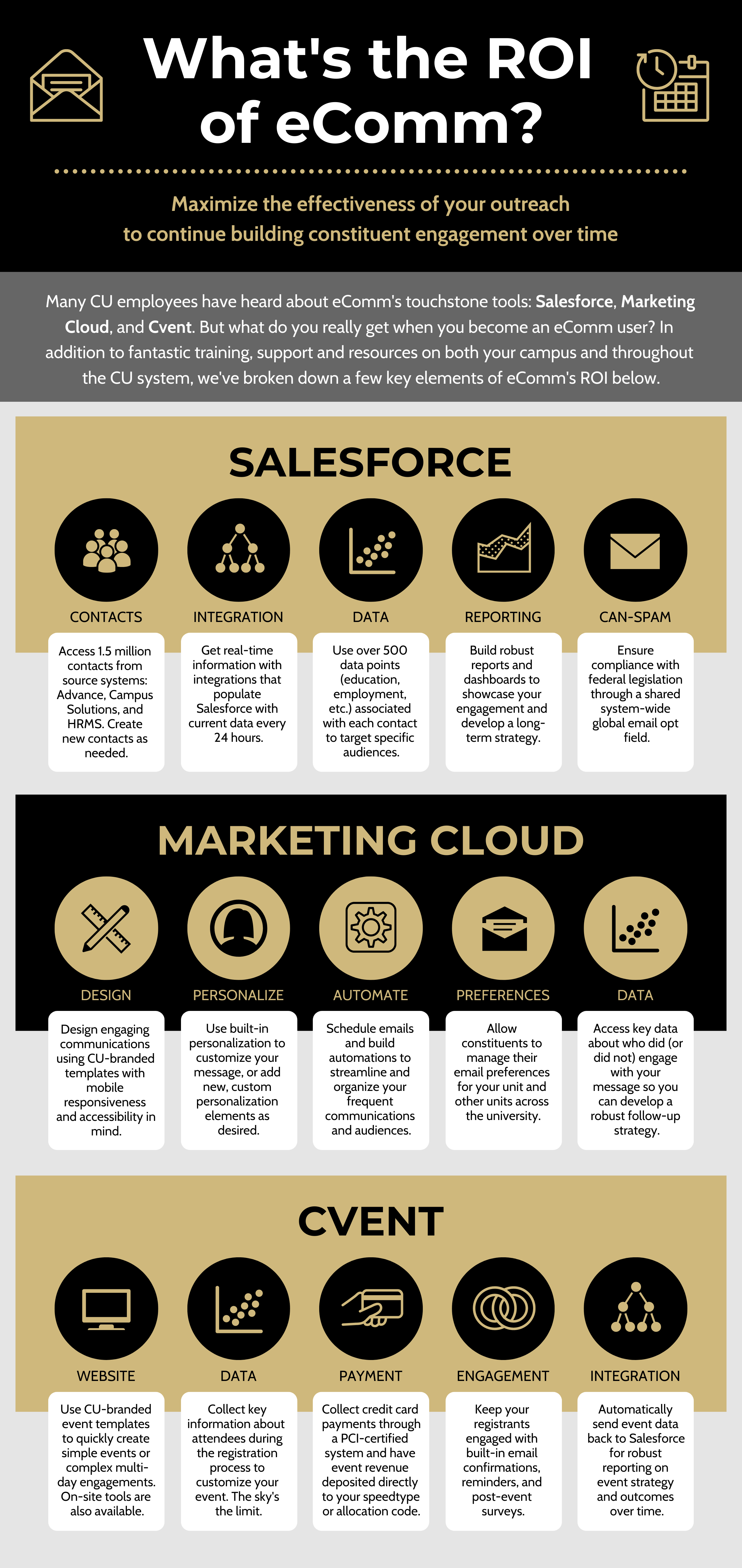
You might know a bit about the tools that make up eComm's platform (Salesforce, Marketing Cloud, and Cvent), but what's the real ROI of eComm for your communication and event management needs? It's a question many users ask, and we're here to help you both understand the value and communicate it to others on your team.
Salesforce is at the heart of eComm, but it would be nothing without other systems across CU. Most of eComm's Salesforce Contacts are from a source system (updated nightly) and enhanced with engagement information from eComm's other applications (Marketing Cloud & Cvent), constituents and eComm specialists.

- Advance | Donors, Friends & Alumni Updates
- Campus Solutions | Academic & Enrollment Details
- Human Capital Management (HCM) | CU Employment Details
- Identity Management (IDM) | Campus-level Affiliations
- eComm Specialist | Contacts that do not exist in one of the above data systems can be created directly in Salesforce by an eComm specialist
- Marketing Cloud | Enhances a Contact by layering on individual email preferences and Individual Email Results (IERs).
- Marketing Cloud and Salesforce have a bi-directional integration meaning a Marketing Cloud email can be distributed to a targetted audience created in Salesforce and data from that email is sent back to Salesforce.
- Cvent | Enhances a Contact by adding event participation (and creates new Contacts when necessary). Cvent supports complex and/or paid events.
- Simple Events | Offers a Salesforce solution for collecting registrations at a low cost - only for simple and free events.
- Form Assembly | Enhances a Contact by including any action taken to subscribe (and creates new Contacts when necessary).
- eComm Specialists | Update a constituent's Email Preferences
- Constituents can adjust their Email Preferences by receiving an email and selecting 'Manage My Preferences' in the footer
- Advance, Campus Solutions & HCM | Updates constituent's First Name, Last Name, or Email (depending on which source system the Contact originated from)
Data Dictionary & Entity Relationship Diagram (ERD)
The data dictionary [19] provides full descriptions and values of fields that exist in Salesforce while the Entity Relationship Diagram (ERD) [20] indicates how the data is related to one another.
2023 Optimization
By implementing a simplified Marketing Cloud business unit and preference model across all campuses, the eComm team will reduce costs, streamline the constituent experience, and decrease the level of backend management needed. The current model has 151 business units and 373 associated preferences. This project aims to reduce these numbers by at least 50%. After thorough analysis, we identified: Any future projects to make Marketing Cloud more robust will be made easier by the simplest and fewest business units and preferences. Future state will require further simplification. Users will fall into one of the following categories and communications have been customized for each individual. If you are unsure which category you fall into, ask your eComm specialist. VARIED CAMPUS TIMELINES
The following timelines are separated by 'pre-move' and 'post-move'. Each campus' move dates are unique and listed below. Content Builder content will be moved a couple of days before the move date resulting in a 'freeze' period. Assets added during this time will not be moved automatically and will need to be re-uploaded when moved to your new account. 'Recently' used Data Extensions will be migrated, relative to the date the campus is moving. Other Users Start Sharing Business Unit
Content Builder
Salesforce Send Emails Tracking Reports / Data Extensions Send Classifications and Sender Profiles Automations / Journey Content Builder, Salesforce Send Emails, Tracking, and Automations
Data Extensions
Send Classifications and Sender Profiles
Other Users Start Sharing Business Unit If other users are creating clutter, please let your eComm specialist know so they can reiterate best practices. Reports / Data Extensions Send Classifications and Sender Profiles Business Unit
Email Preferences
Reports / Data Extensions
Data Extensions If others are creating clutter, let your eComm specialist know so they can reiterate best practices.
VARIED CAMPUS TIMELINES
*FOR THOSE MOVING FROM BUSINESS UNIT TO BE DELETED
While most Business Units are experiencing changes, some will actually be deleted. You can ask your eComm specialist for items until the dates indicated below, but after will be erased with no method of recovery.
CU Adv-UCCS Annual Giving UCCS Events CU Adv-Denver Annual Giving CUA & UCD Police Department CU Advancement CU System Office of Outreach & Engagement CU Adv-Anschutz Annual Giving CUA Alzheimer's & Cognition Center Clean-Up You'll need to work with your eComm specialist to modify or remove Data Extensions and Send Classifications that are no longer needed. Users are encouraged to create/modify a Folder structure and organize assets within Content Builder. Instead of deleting assets, create a Folder named 'zArchive' , then move items you want 'deleted' to the folder. This gets unneeded assets out of the way without the risk of accidentally deleting items, particularly ones that turn out not to be 'yours'. Learn how to create folders and move assets [24]. Content Builder, Salesforce Send Emails, Tracking, and Automations
Business Unit
Email Preferences
Data Extensions NOTE: Delete Data Extensions in both areas! Send Classifications and Sender Profiles Business Unit Email Preferences Data Extensions & Reports Send Classifications and Sender Profiles Full Process for Un-Archiving (for eComm specialists)
A new audience request can get you to the same end goal although unarchiving when possible is far more efficient. Note that items followed by a * can only be completed with the help of your eComm Specialist [29].Preference and Business Unit Optimization [21]
Why
Justification
Benefits
Results
Business Units
Campus
# of Old Business Units
# of New Business Units
Number Reduced
Advancement
14
11
3
Anschutz
37
18
19
Boulder
41
26
15
Denver
21
14
7
System
15
6
9
UCCS
17
10
7
Misc (Test & Parent)
2
2
0
Total
147
87
60
Preferences
# Old Preferences
# New Preferences
Number Reduced
Advancement
5
3
2
Anschutz
84
45
39
Boulder
163
136
27
Denver
44
25
19
System
17
13
3
UCCS
16
25
-9
Total
329
248
81
User Impacts
POST-MOVE
PRE-MOVE
POST-MOVE
PRE-MOVE
POST-MOVE
User Training
Organization Across Marketing Cloud
Email Preferences & Audiences
UCCS | Business Units to be Deleted July 31
UCCS Alumni Relations
UCCS Comm and Marketing
UCCS Downtown
UCCS Institute for Human Resilience
UCCS Office of Diversity, Equity & Inclusion
UCCS Office of ResearchCU Denver | Business Units to be Deleted July 31
CU Adv-Denver Development
CUD Business Career Connections
CUA & UCD Office of Information Technology
CU Denver Police Department
CU Denver Office of Regulatory Compliance
CU Denver Facilities ManagementCU SYSTEM | Business Units to be Deleted Aug. 31
CU System COLTT
CU System Faculty Council
CU System Government Relations
CU System Policy, Efficiency, and Audit
CU System Office of the University Controller (OUC)
CU System Procurement Service CenterCU ANSCHUTZ| Business Units to be Deleted Aug. 31
CUA Diversity & Inclusion
CUA & UCD Office of Information Technology
CUA Strauss Library
CUA University Events
CUA School of Medicine - Anesthesiology
CUA Infectious Diseases
CUA School of Medicine - Ob-Gyn
CUA School of Medicine - Physical Medicine
CUA Psychiatry
CUA Bioethics & Humanities Center
CUA Center on Aging
CUA Center for Personalized Medicine
CUA Diabetes Research Center
CUA Gates Center
CUA Health & Wellness Center
CUA JFK Partners
CUA Ludeman Center
CUA and CUD Office of Regulatory ComplianceeComm Specialist Impacts & Training
PRE-MOVE
POST-MOVE
Related Wikis
2019 eComm Migration

Latest Updates [30] Center of Excellence [31] Contact Us [3]
Every day, communicators throughout the CU System rely on the eComm program [32] to build and strengthen relationships with their constituents, including students, alumni, donors, faculty, and staff. An integral component of these efforts is ensuring that Salesforce, Marketing, Cloud and Cvent work in concert with one another and with minimal technical disruption, an effort jointly supported by the eComm team [29] in the Office of the President and the CRM Center of Excellence (COE) [31] housed on the Boulder campus.
- Summary
- UCCS & System
- Denver & Anschutz / Denver & Anschutz Advancement
- Boulder & Boulder Advancement
- FAQ
- The Team
 WHAT & WHY
When the eComm program as we know it today launched in 2016, the Salesforce environment that is the data backbone of communication efforts existed in the same technical space as student success CRM efforts on the Boulder campus. While this shared space allowed eComm to achieve its goals, continued program growth has presented challenges for both the eComm and student success teams. A few of these challenges include but are not limited to data integrity, integration between data source systems and Salesforce, overall platform stability given the volume of users and data housed, and visibility of data based on its relevance to the team being supported.
 WHEN
In fall 2018, the COE launched a project to address these and other issues: eComm Upgrade. This project will move eComm users, data, content, and functionality off of the current shared environment with Boulder student success to a new space that will be eComm-specific. The goal of the project is to ensure that eComm users have access to the data that they need to communicate effectively and that the data is accurate, timely, and usable in a powerful way to increase constituent engagement throughout the CU System.
 HOW
While the eComm upgrade is a technical change that will not result in disruptions or gaps in communication, eComm Specialists across CU will support project efforts by reviewing current audience reports for relevance and accuracy and by working with eComm’s over 300 users to build and refine outreach strategies that will truly maximize the power of the eComm tools. eComm’s new Salesforce environment will be completed and extensively tested by April 1, 2019. At that time, the COE will work with eComm Specialists to begin moving users from our current shared environment to the eComm-specific one.
 IMPACT
The change should be seamless - while some login information and processes will change, usability will not be affected, and users will be able to continue sending their communications as normal. The shift to the new environment will also be gradual. Rather than moving all eComm users at once, the COE will work with eComm Specialists to conduct a rolling migration of users based on planned communication and outreach efforts so that the impact of the technical change is minimal. The COE expects to begin migrating users in April 2019 with a completion goal of May 2019. For further questions about the impact, see the "FAQ" tab.
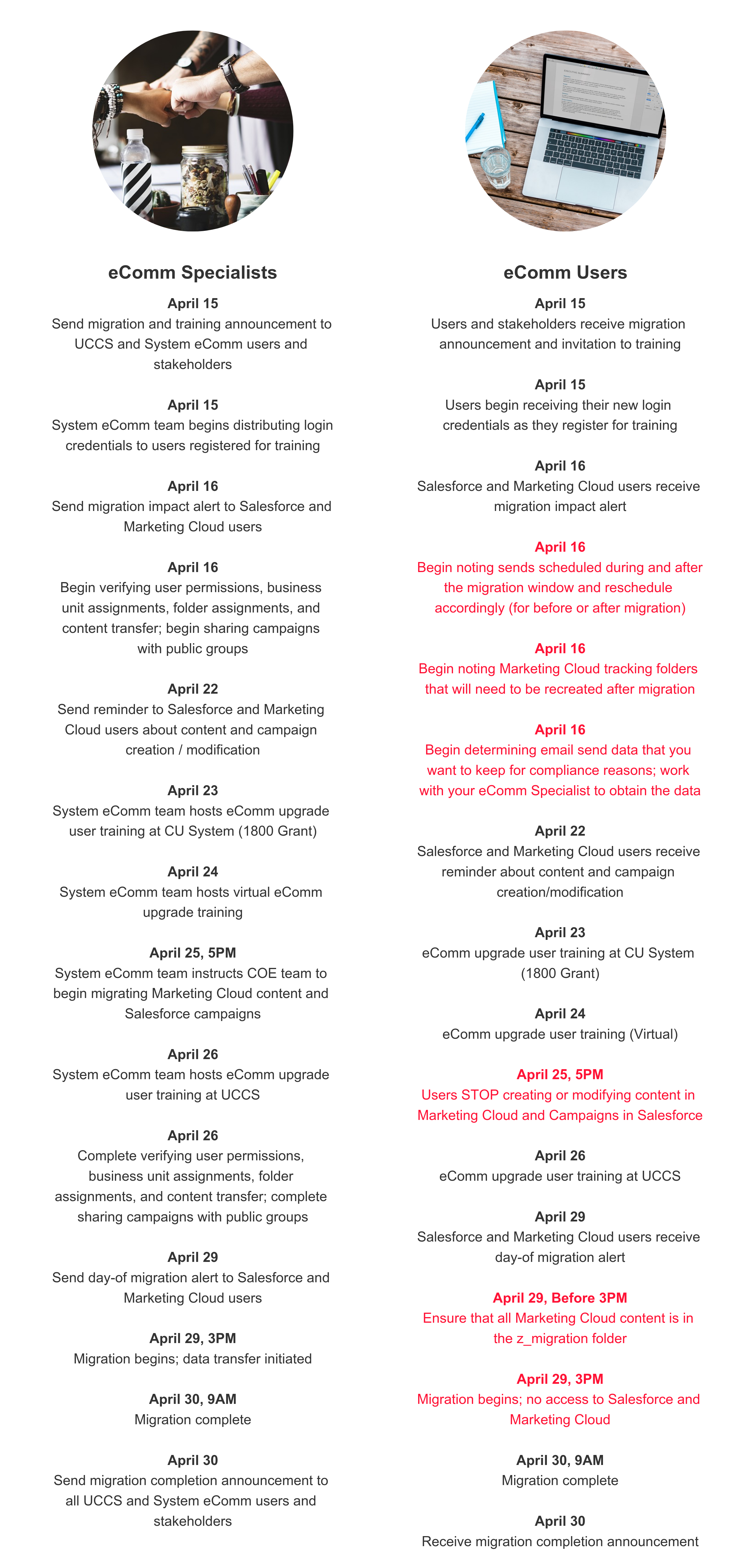
UCCS AND CU SYSTEM MIGRATION
UCCS and CU System eComm users will migrate to the new org on April 29-30, 2019. A timeline for the migration is below.
Required Training
Required training will be offered on the dates and times below. The migration will directly impact Salesforce and Marketing Cloud users, who are required to attend training. Although the migration will not directly impact Cvent-only users, they are encouraged to attend training to learn about enhanced Cvent-Salesforce integration launching with the eComm upgrade.
- Tuesday, April 23, 10:00 a.m. - 12:00 p.m., CU System (1800 Grant St.) | REGISTER [33]
- Wednesday, April 24, 10:00 a.m. - 11:00 a.m., Virtual | REGISTER [34]
- Friday, April 26, 10:00 a.m. - 12:00 p.m., UCCS | REGISTER [35]
Registration will be available beginning on Monday, April 15.
Additional Resources
- Migration Impact [36]
- Key Changes [37]
Timeline
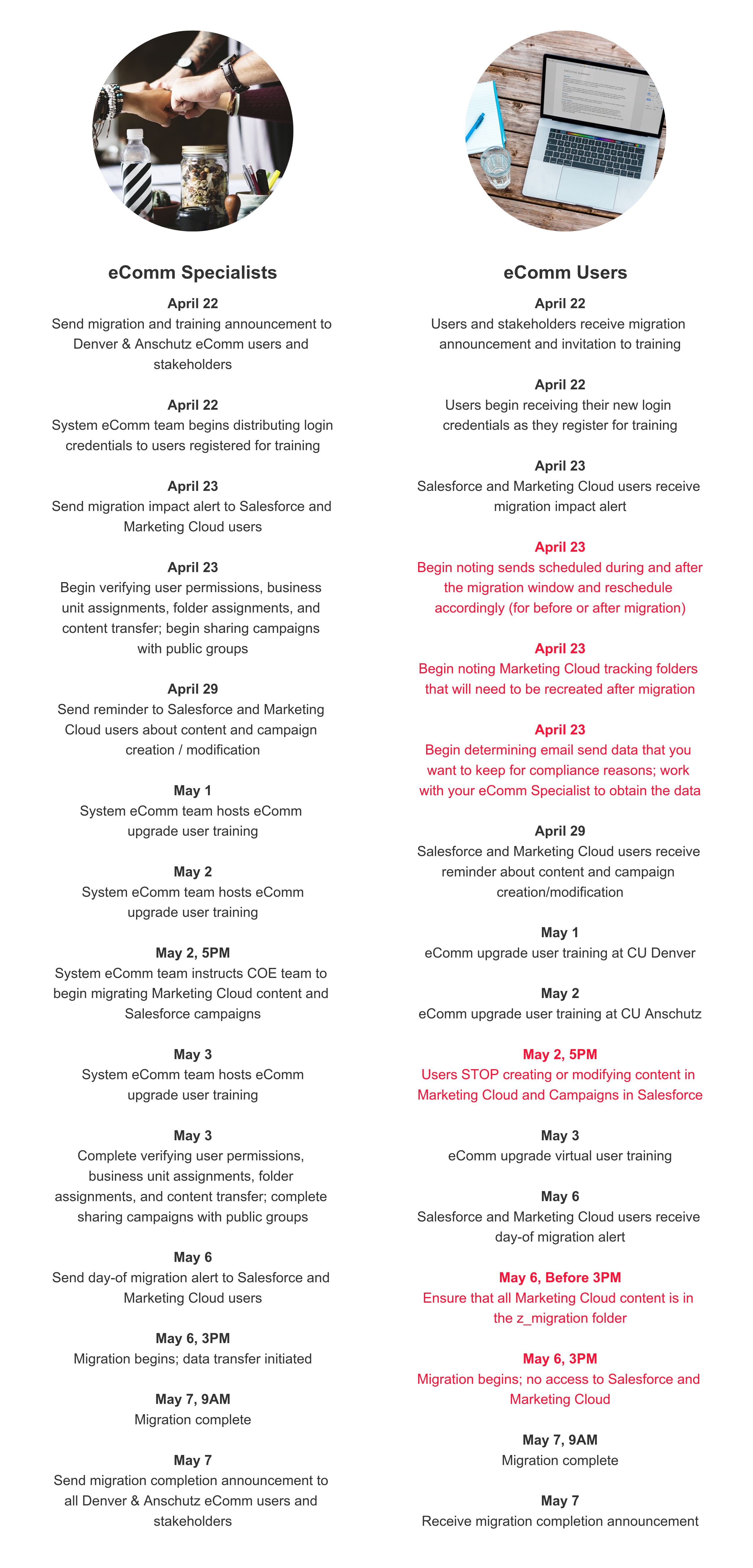
CU DENVER, CU ANSCHUTZ, & CU DENVER AND ANSCHUTZ ADVANCEMENT MIGRATION
CU Denver and CU Anschutz Medical campus eComm users (as well as Advancement users on those campuses) will migrate to the new org on May 6-7, 2019. A timeline for the migration is below.
Required Training
Required training will be offered on the dates and times below. The migration will directly impact Salesforce and Marketing Cloud users, who are required to attend training. Although the migration will not directly impact Cvent-only users, they are encouraged to attend training to learn about enhanced Cvent-Salesforce integration launching with the eComm upgrade.
- Wednesday, May 1, 10:00 a.m. - 12:00 p.m., CU Denver | REGISTER [38]
- Thursday, May 2, 10:00 a.m. - 12:00 p.m., CU Anschutz | REGISTER [39]
- Friday, May 3, 1:30 p.m. - 2:30 p.m., Virtual Training | REGISTER [40]
Registration will be available beginning on Monday, April 22.
Additional Resources
- Migration Impact [36]
- Key Changes [37]
Timeline
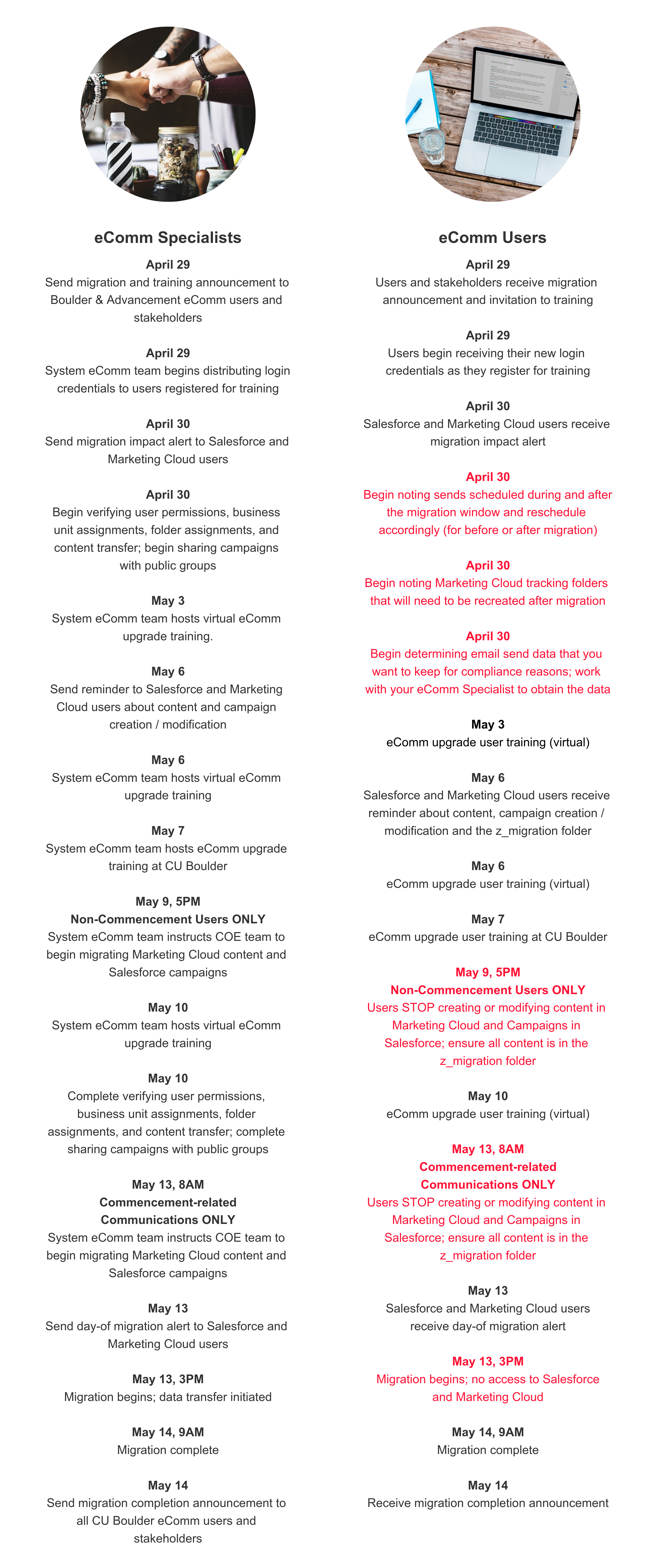
CU BOULDER & CU BOULDER ADVANCEMENT MIGRATION
CU Boulder and CU Boulder Advancement eComm users will migrate to the new org on May 13-14, 2019. A timeline for the migration is below.
Training
Training will be offered on the dates and times below. The migration will directly impact Salesforce and Marketing Cloud users. Although the migration will not directly impact Cvent-only users, they are encouraged to attend training to learn about enhanced Cvent-Salesforce integration launching with the eComm upgrade.
- Friday, May 3, 1:30 p.m. - 2:30 p.m., Virtual | REGISTER [40]
- Monday, May 6, 2:00 p.m. - 3:00 p.m., Virtual | REGISTER [41]
- Tuesday, May 7, 9:00 a.m. - 11:00 a.m., In-Person Training at CU Boulder | REGISTER [42]
- Friday, May 10, 10:00 a.m. - 11:00 a.m., Virtual | REGISTER [43]
Additional Resources
- Migration Impact [36]
- Key Changes [37]
Timeline
FAQ
While we do our best to anticipate all of the questions you might ask, we recognize that we likely did not capture all of them. If you have a question or concern not addressed below, please reach out to us for assistance.
Jump to Marketing Cloud FAQ | Jump to Salesforce FAQ | Jump to Cvent FAQ
General
Why is eComm moving to a new Salesforce environment?
What will be different?
- Enhanced Cvent integration
- Improved eComm-specific page layouts in Salesforce
- A hospital email field for CU Anschutz and an IdentiKey email field for CU Boulder
- A field-change history for eComm-defined fields in Salesforce
- Elimination of ability to view business contacts, which are not relevant to eComm users
- Enhanced training on report building and audience selection to achieve strategic goals
- Enhanced training on Salesforce campaigns
What will stay the same?
What do I need to do as part of this process?
- Conduct a review of your current and future audience reporting needs so that old reports can be eliminated and the accuracy of current reports can be verified
- Conduct a review of your Marketing Cloud content to eliminate unnecessary items and prepare needed content for the transition to the new environment
Marketing Cloud
Will I need a new user name and password?
Will there be a time period in which I am unable to send emails?
Will I be able to keep my Marketing Cloud content?
Will I still be able to access my tracking data for email sends?
Will my Journey Builder and Automation Studio content remain available?
Will my data extensions still be available?
What if I have email content in Classic Content and Content Builder?
Will I still be able to use dynamic content and A/B testing?
Will Marketing Cloud look different?
Will my constituents' email preferences remain the same?
I don't use Marketing Cloud as much as I thought I would. Do I have any options to save money with this transition?
Salesforce
Will I need a new user name and password?
My audience reports and campaigns are stored in Salesforce. Will I still be able to use them?
Will I still be able to email campus email fields?
Will my constituents' email preferences remain the same?
My eComm Specialist built dashboards for me. Will I still be able to access them?
Will Salesforce look different when I login?
Will I ever be able to send email through Salesforce?
Cvent
Will I need a new user name and password?
Will my events and associated data still be available?
Will all of my images and content still be available?
Will my eComm Specialist still be able to integrate my event with Salesforce?
Will Cvent look different when I login?
PROJECT TEAM
Questions about the work taking place for the eComm upgrade? Please contact us [3] for assistance.
 Nalini Indorf Kaplan
Director, Enterprise CRM, Center of Excellence
 Jennifer Mortensen
Executive Director of Electronic Communication, Office of the President
 Nonie Roberts
Senior Business Analyst, Center of Excellence
 Lisa Carr
Senior Business Analyst, Center of Excellence
 eComm Specialists
The above team also works closely in a collaborative partnership with 15 eComm Specialists [29] across the CU System to ensure that the eComm upgrade meets the needs of CU communicators.
2015 Implementation
Preliminary Schedule
NOTE: Schedule may change as requirements change and details will be added accordingly. However, overall goal is to deploy and have all users trained by October 2015.| Date | Description | Details | More Information |
|---|---|---|---|
| Dec. 8 - 12, 2014 | Discovery, on-site | CU's eComm implementation partner ACF Solutions will be in Denver for five days to become more familiar with our needs and systems, which will define the eComm implementation plan. Discovery sessions will be held throughout the week at the CU System offices at 1800 Grant St. | Schedule [45] |
| Jan. 5 - 12 | ACF and CU define requirements | ACF Solutions and CU will review the information gathered during the Discovery week to define requirements. A requirements document will be available by January 12, 2015. | |
| Feb. 25 | Virtual Town Hall | Project Update: open to all eComm users and stakeholders. Email Kim at kim.egan@cu.edu [46] to receive a calendar invitation. |
Town Hall survey [48] FAQs [49] |
| Jan. - Feb. | Design | ACF Solutions will use requirements to design implementation. A design document will be available by Feb. 1, 2015. | |
| Jan. - March | Build | ACF Solutions will work in close partnership with CU to build the custom eComm solution. This includes data migration and integration as well as development for ExactTarget, roundCause Events and the online community. | |
| April 28 | Second Virtual Town Hall | Your eComm team will provide a project update, give you a peek at the alumni online community, discuss upcoming training and review Harris sunsetting milestones. |
Town Hall Recording [50] FAQs [51] |
| June 23- 25 (Tues.-Thur.) | User Acceptance Testing (UAT) | The eComm Super User group will test the eComm solution and provide feedback. ACF Solutions will modify accordingly. | Visit the 'Who's Involved' tab for a complete list of Super Users |
| July 9 | Third Virtual Town Hall | Your eComm team will provide a project update, discuss upcoming training, review Harris sunsetting milestones and answer attendees questions. |
Town Hall PowerPoint [52] Town Hall Recording [53] Salesforce 101 [54] FAQs [55] |
| Sep. 28 | Super Users migrate to production | Super Users will gain access to the Salesforce/Marketing Cloud production environment | Visit the 'Who's Involved' tab for a complete list of Super Users |
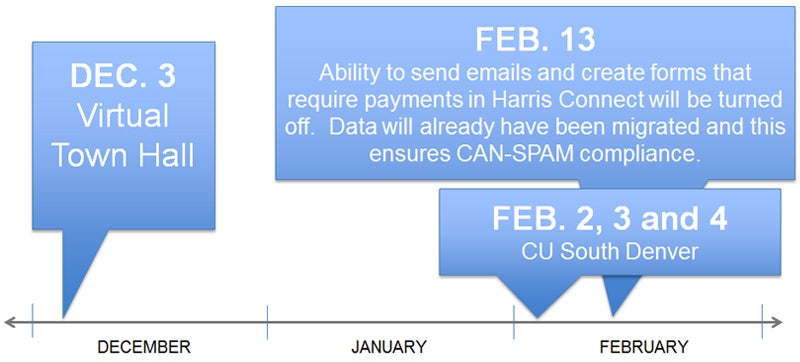
| Dec. 3 | Fourth Virtual Town Hall | Your eComm team will provide a project status update and announce details for Salesforce training, eCommference. | Town Hall PowerPoint [57] |
| Jan. 11 (week of) | All User Training | Training of eComm users set for January 2015 | |
| Jan. 11 (week of) | Cutoff date for sending emails via Harris | Users can still login to Harris Connect but will NOT be able to send a communications. Event registration and membership forms will still be functional. | Archiving content in Harris [58] |
| Feb. 2016 | Harris sunsets | Users can no longer login to Harris Connect |
Scope of Work [59]
eComm Data List [60]
If you would like a specific power point presentation, please email Kim at kim.egan@cu.edu [61].
We have selected a group of vendors to replace Harris Connect for the university’s eComm program. Salesforce [62] will be our new constituent relationship management (CRM) database. ACF Solutions [63] will provide the professional services to help build the custom eComm environment. Marketing Cloud [64] (formerly known as ExactTarget) will be our email marketing tool.
Leadership Team
Project Sponsor: Ken McConnellogue, Vice President Communication, Office of the President University Relations
Project Manager: Kim Egan [46], Electronic Communication Director, Office of the President University Relations
Milap Sharma [65], Director of Application Development, University Information Services (UIS)
Nalini Kaplan [66], CRM Director, CU-Boulder Office of Information Technology (OIT)
Jason Hunter [67], Director of Technical Projects Office of Performance Improvement (OPI)
eComm Campus Program Managers
CU System: Melanie Jones [68]
CU Colorado Springs: Megan Gallegos [69]
CU Denver | Anschutz Medical Campus: Nonie Wainwright [70]
CU-Boulder: Erin Frazier [71], Tom Needy [9] and Rachel Vaccariello [72]
Advancement: Matt Roush [73]
Discovery Week
Alexis Kelley
Amanda Ulrey
Cathy Beuten
Chirag Joshi
Dave Kohnke
Dennis Lindvedt
Erin Frazier
Heather Cuff
Jack Strober
Jack Vertovec
Jason Armbruster
Jason Hunter
Jay Dedrick
Jennifer Hane
Joanna Iturbe
Joe Tinucci
Jon Arnold
Joy French
Julann Andresen
Julie Mullin
Karen Ichiba
Karen Klimczak
Ken McConnellogue
Kim Egan
Lisa Carr
Matt Duncan
Matthew Kaskavitch
Megan Gallegos
Melanie Jones
Melissa Cech
Michele McKinney
Milap Sharma
Molly Doyle
Nalini Kaplan
Nischal Dangol
Peter Burke
Philip Denman
Rachel Vacceriello
RyAnne Scott
Sharon Grant
Steve Tapp
Tom Needy
Travis Chillemi
Valerie Skillern
Super User Group
This group will be part of the User Acceptance Testing (UAT) portion of development and will receive classroom-style training directly from the vendor.
CU System
Lisa Carr
Kim Egan
Melanie Jones
Michele McKinney
RyAnne Scott
Valerie Skillern
Advancement
Matt Roush
CU-Boulder
Melissa Cech
Nischal Dangol
Matt Duncan
Crystal Eilerman
Erin Frazier
Caro Henauw
Joanna Iturbe
Laura Kriho
Teagan Lochner
Sarah Martens
Tom Needy
Mirinda Scott
Greg Swenson
Rachel Vaccariello
CU Denver
Julia Cummings
Monica Cutler
Chad Reiling
Rebecca Ward
CU Anschutz Medical Campus
Stephanie Aguinaldo
Heather Cluff
Amanda Gonzales
Michael Miller
Nonie Wainwright
Stephen Tapp
CU Colorado Springs
Jennifer Hane
Megan Gallegos
We want to hear from you.
Go here [74]to document desired functionality.
Go here [75]to submit a question or comment.
Director, Electronic Communication
University Relations, Office of the President
kim.egan@cu.edu [76]
(303) 828-8886