DRAFT - Strategic Plan 2.0 Sample Page [1]
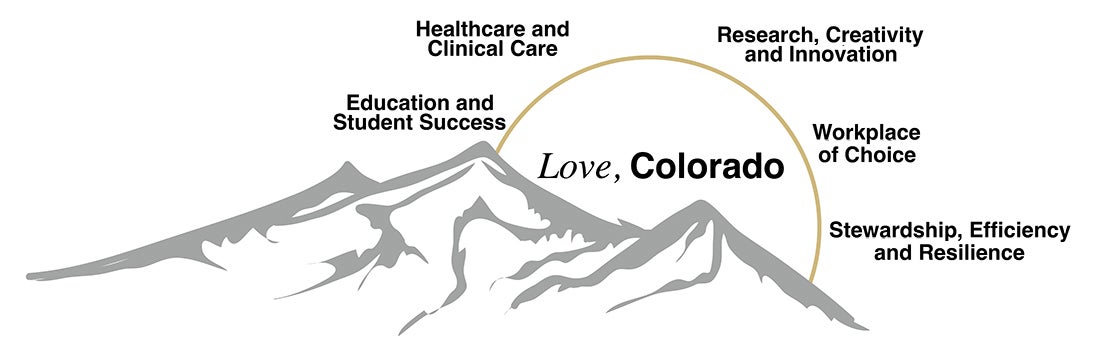
CU is committed to being a premier, accessible and transformative public university that provides a quality and affordable education with outstanding teaching, learning, research, service, and health care. Through collaboration, diversity, innovation, technology and entrepreneurship, CU fosters student success and strengthens Colorado’s economic foundation.
For more information on CU Strategic Planning, visit cu.edu/strategic-planning [2]
Education & Student Success
Enrollment
Fall census enrollment, all levels, degree-seeking + non-degree-seeking, with state reportable hours. This data includes incoming first-time and transfer students, continuing students, and non-degree seeking students. Course enrollment may be in-person, online, or a combination of both.
First-Time Student Retention Rates
Retention rates are based on first-time undergraduate students starting in fall term returning for 2nd fall term. Cohort is based on first-time, full-time enrolled students in summer/fall term enrollment, excluding deceased students.
Rates are not calculated for CU Anschutz
Incoming Undergraduate Persistence Rates
”Persistence” rates are based on first-time & transfer undergraduate students starting in fall term returning for 2nd fall term. Cohort is based on full-time & part-time, first-year & transfer students enrolled in summer/fall term, excluding deceased students.
Rates are not calculated for CU Anschutz
Graduation Rates
Graduation rates are a key indicator of how many undergraduate students who start as full-time freshman earn their degrees within four to six years. Students earning 30 or more credits per year will earn their degree within four years. Students graduating within six years is more common.
Rates are not calculated for CU Anschutz
Healthcare & Clinical Care
Patients Served by Anschutz Clinical Faculty
University of Colorado serves the entire state of Colorado in both education and health care. This data reflects the number of patients served by CU Anschutz clinical faculty.
Research, Creativity, and Innovation
Research Awards
Sponsored research awards and gifts supporting research are restricted funds dedicated to research activities. Awards are dollars sourced from federal agencies and non-federal entities such as state and local government, non-profit and private organizations, and other institutions.
Workplace of Choice
Employee Retention
This voluntary retention rate is based on a cohort of non-temporary employees who were active on the first day of the time period and still active on the last day of the reporting period, excluding supplemental faculty, other faculty, involuntary separations, and retirees.
Stewardship, Efficiency, and Resilience
Fundraising
Fundraising is based on dollars donated to the university. Total donations include outright gifts, pledge commitments, and matching gifts.
Additional Campus Metrics
- Qualitative | Implement campus inaugural Common Curriculum
- Qualitative | Implement high-impact experience initiative
- Qualitative | Advance a validated model for employee health and well-being and expand access to mental health and family support services
- Qualitative | Implement Student Flourishing initiative recommendations
- Qualitative | Enhance campus safety through security system upgrades and CU Boulder Safety App
- Quantitative | Academic Analytics Scholarly Research Index Percentile (all)
- Quantitative | Association of University Technology Managers, AUTM Startup Ranking (in top 10 every year)
- Qualitative | Rankings (National and Global) – Develop a strategy to improve
- Quantitative | Increase participation in Engagement Survey
- Quantitative | Increase Engagement Score (Campus Overall)
- Qualitative | Update Climate Action Plan with scope three emissions
- Qualitative | Expand efforts for waste reduction
- Qualitative | Expand sustainability educational and research opportunities
- Qualitative | Increase sustainable transportation
- Qualitative | Create an enrollment center to provide easy access and support for all students
- Qualitative | Conduct a market analysis to identify high demand programs for online or hybrid expansion
- Qualitative | Ensure that all undergraduate students have access to at least one career-connected or civic/community-engaged learning experience
- Pending
- Increase federal research agency proposal submissions
- Qualitative | Develop an internal competitive award process to support student research
- Qualitative | Develop Innovation Goal
- Qualitative | Implement consistent onboarding and early-career experience programs
- Qualitative | Create a university-wide action plan to improve employee wellbeing, belonging, and workplace experience
- Qualitative | Create a coordinated statewide donor and partnership plan
- Qualitative | Identify efficiencies through organizational redesign, shared services, academic and non-academic program optimization
- Qualitative | Implement campus-wide waste reduction education initiatives
- Quantitative | Expand Direct Admissions Agreements with Denver Metro Area Districts
- Qualitative | Develop innovative approaches to serving international students
- Qualitative | Develop more interventions to support retention, persistence, and completion through early action on student challenges
- Qualitative | Launch a comprehensive Student Mental Health and Wellbeing Initiative
- Qualitative | Develop plan for an Innovation and Entrepreneurship Hub in partnership with City and County of Denver
- Qualitative | Enhance the visibility of research
- Qualitative | Expand institutional involvement in Community Engaged Research
- Qualitative | Revitalize efforts to build learning and professional development capacity for employees
- Qualitative | Launch a Comprehensive Employee Mental Health and Wellbeing Initiative
- Qualitative | Standardize change management processes to build employee skills and meet strategic goals
- Qualitative | Develop and complete Climate Action Planning
- Qualitative | Conduct Infrastructure Decarbonization Feasibility Study
- Qualitative | Create and manage a comprehensive Campus Space Utilization Review and Planning Exercise
- Qualitative | Implement SOM three year MD degree (start summer 2027) and use AI to potentially reduce labor burden for all
- Qualitative | CSPH realign curriculum to current and future demands in public health
- Qualitative | Use AI to implement and dramatically improve precision medicine
- Qualitative | Improve quality rating principles and outcomes to enhance care in adult affiliate clinical locations
- Quantitative | Increase Patents Awarded
- Qualitative | Continue to develop Data 2.0 strategy
- Qualitative | Improve rankings national and global
- Qualitative | Expand staff professional development programs that align with organizational needs including AI learning paths
- Qualitative | Strengthen and sustain a competitive total rewards strategy
- Qualitative | Use AI to Modernize administrative operations
- Qualitative | Expand Green Labs Program
- Qualitative | Implement Data Drive, Flexible Space Utilization Strategy
- Qualitative | Develop Campus-Wide Waste Diversion Strategy
- Conduct study and report on CU Alumni Outcomes
- Employee Engagement Survey Results